How many laptops?!
Here are some numbers from recent education news stories:
- Schools Week reports that the Government delivered 876,000 laptops to schools since the scheme started in April last year.
- Fiona Millar, in the Guardian, writes that the most expensive free school, Harris Westminster sixth form, cost almost £50m to set up.
- The EEF estimates the pandemic caused Year Two pupils to fall two months behind in reading and maths compared to previous cohorts.
Some of these numbers sound quite big. But are they really that big? To make sense of numbers in the news we often need to compare them to something else.
876,000 laptops certainly sounds like a lot of laptops. But if you shared them equally across the 24,000 English schools, there would be about 35 laptops for each school. Now 876,000 might not sound quite so impressive…
Making education add up
One of my favourite Christmas presents was How to Make the World Add Up, the new book by Tim Harford. Tim presents More or Less and writes brilliant books on economics and statistics.
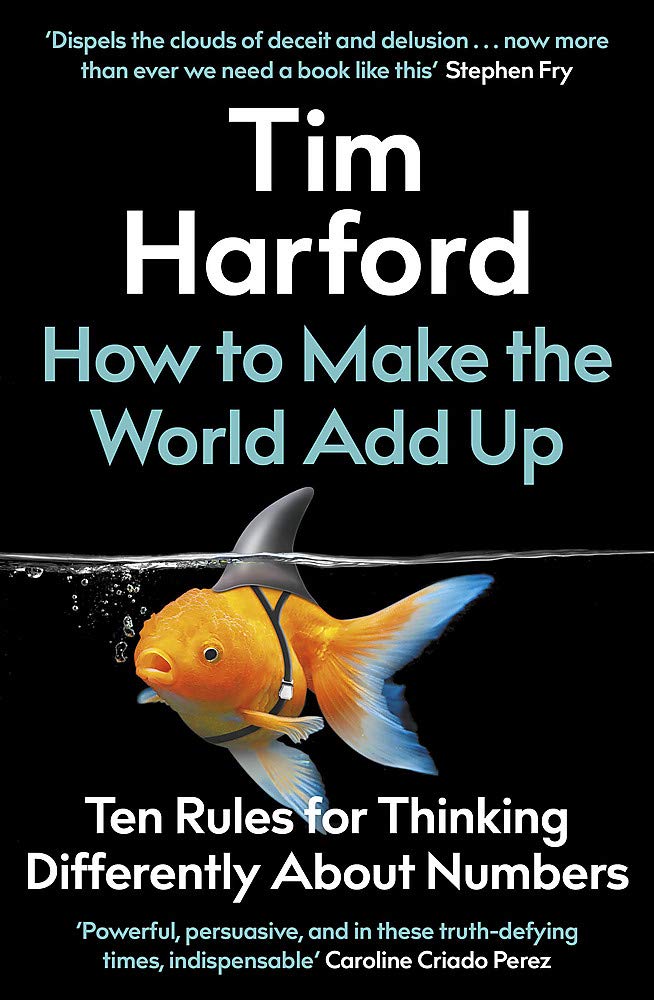
Tim’s new book includes this great idea: ‘landmark numbers’. These are numbers which you can easily use to judge the size of other numbers. For example, knowing that there are about 24,000 schools in England isn’t just useful for thinking about laptops. You might also find it useful when reading about the extent of academisation, teacher recruitment statistics, or the latest school funding announcement.
Learning a few landmark numbers has helped me think a bit more critically about the education news. Of course you can look them up and sometimes you do need to look up the right number for the job. But I do find that having them lodged in my memory helps me quickly make more sense of what I read.
Anyway, this is straying dangerously close to the ‘who needs knowledge, you can just look it up’ debate. Let’s move swiftly on. I’ll end with some suggestions for useful landmark numbers in education. Next time you see an eye-catching number, ask yourself: ‘Is that really a big number? What could I compare it to?’
How much?
- The UK spends about £91 billion on education every year or 4.2% of national income. About £50 billion of this is spent on schools. (IFS).
- The UK spends about £50 million a year (or one free school in Westminster…) on education research (Royal Society).
- It costs £200 million to deliver GCSE exams – equivalent to £52,000 per school. (EDSK)
- The current (2021) pupil premium allocations are £1,345 for every primary age pupil and £955 for every secondary age pupil.
How many?
- There are 24,000 schools in England. This includes 1,000 special schools, 16,800 primary schools and 3,500 secondary schools. (DfE)
- There are 8.89 million pupils in English schools. There are about 560,000-670.000 pupils in a year group. (DfE)
- 17.3% of pupils are known to be eligible for free school meals. (DfE)
- There are 450,000 FTE teachers and 270,000 FTE Teaching Assistants. (DfE)
How effective?
You have to be careful when comparing effect sizes as they are influenced by much else besides the effectiveness of an intervention. The context of the study, what happens in the control group, and the choice of outcome measure all play a role. That doesn’t mean that comparison is totally useless – knowing some landmark effects can still provide a useful starting point for thinking about impact.
Here are some useful ‘landmark’ effects.
| Intervention | Effect size (standard deviations) |
| Tutoring (Nickow et al, 2020) | 0.37 |
| Teacher with a decade’s experience, compared to a novice (Papay and Kraft) | 0.1 |
| Professional development (EPI) | 0.09 |
| Average impact in EEF- and NCEE-funded evaluations (Lortie-Forgues and Inglis, 2019) | 0.06 |
| Achievement for All, on reading (EEF) | -0.12 |
| COVID-19 school closures, on reading (EEF) | -0.17 |
Further reading
- Tim Harford’s ‘How to Make the World Add Up’ of course.
- http://www.isthatabignumber.com/ has lots more on the topic!
- Matthew Kraft’s brilliant paper on interpreting effect sizes in educational research
 Peter Henderson
Leave a comment